"Same Market, Same Team": What Changed When Gia Terziyska Went From $4.6M to $12.5M in 6 Months
Gia Terziyska is a team broker at Vesta Preferred Realty in Chicago. She moved to Chicago from Bulgaria nine years ago without speaking English, and spent a few months at another brokerage without closing a single transaction before joining Vesta.
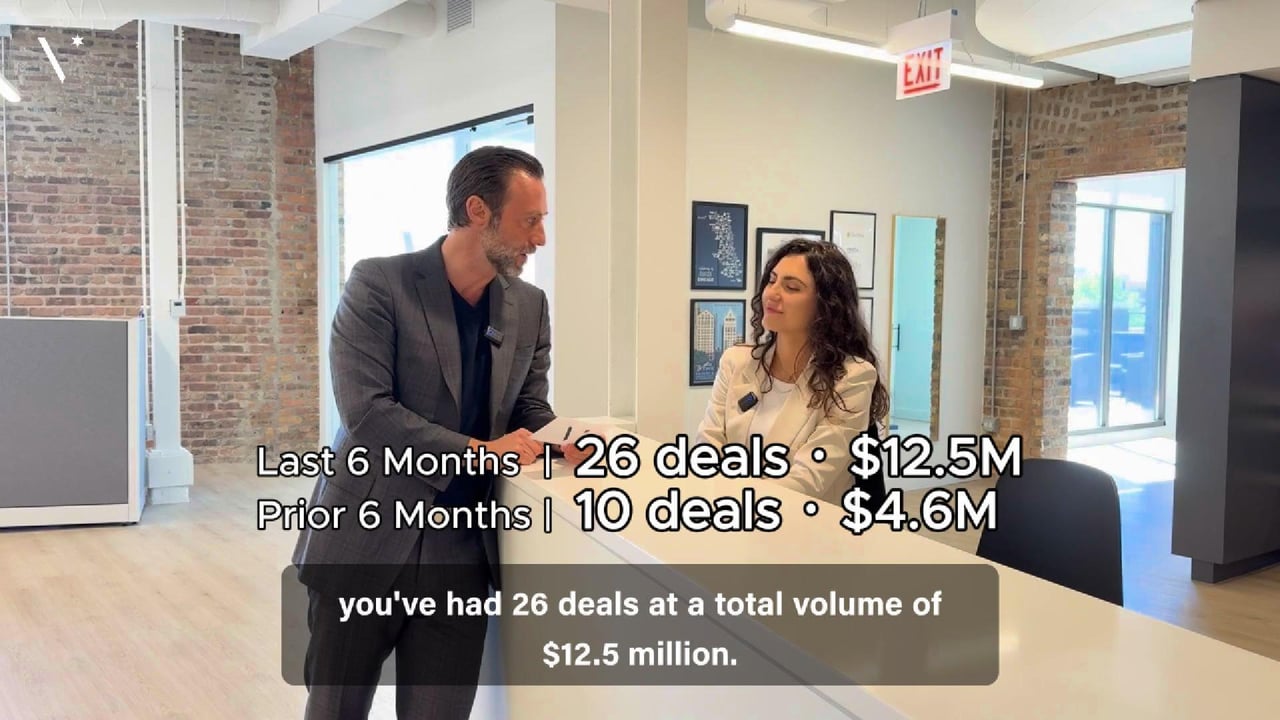
In a recent six-month period she closed 10 deals for $4.6 million. In the six months that followed, 26 deals for $12.5 million — as an established agent, not a new one. This is her conversation with managing broker Grigory Pekarsky about what changed in between.
Are you originally from Chicago?
Gia: No, I'm actually originally from Bulgaria, so I moved to Chicago about nine years ago, and I didn't know the language — which was one of the hardest things for me once I moved here, to start from zero.
What do your numbers look like?
Grig: Let's speed up nine years and go through your numbers, because these numbers are out of this world. You've had 26 deals at a total volume of $12.5 million. And the six months prior to that, you had 10 deals at a total of $4.6 million. So obviously there's a lot to unpack there.
You've had tremendous growth, even as you're pacing and speeding up. I want to peel back the layers a little and figure out how somebody who moved here nine years ago and didn't know the language is now riding on the highest of highs of real estate success.
What was it like before you came to Vesta?
Gia: Before I started at Vesta, I was with another brokerage for a few months, and I did not have any mentorship, any support. I did not do a single transaction before I moved to Vesta Preferred.
So that was one of the things I think is really important — to have the right team for you. When I came to Vesta, I saw a really big opportunity. I saw the growth. I found myself in the right team, who actually helped me grow and be able to succeed in a very short period of time.
Grig: I still remember our interview. You were sitting in the actual office of that last brokerage and there was no one around you. And you were just like, "I want to be successful. I don't know the tools on how to. I don't know who to turn to. I'm just looking for how."
That is honestly one of the main connecting fibers of everybody at Vesta. I always say we don't look to make anybody great — you've either got it or you don't. And from the second I was talking to you, I knew you had it. You were hungry. You were like, what do I need to just run through that wall?
Gia: That's what I wanted too. I felt that right at the moment when I talked to you and Brad. I just wanted to be a part of this team. I knew it from the moment I walked in the door — I'll be really happy here, and I will succeed here.
What should I ask when I interview brokerages?
Grig: If somebody's trying to find the right place to start and have the best chance of success in their personal real estate career — what are some questions they should be asking when they go out and interview brokerages?
Gia: First, what's the process? Do you have a specific system to help us grow?
Second, do you have leads? That's what helped me here at Vesta.
And third, how is the process itself for the brokerage? Do we have one-on-one meetings? Do we do all those things that help us grow? Do we have a partnership where if I go to other agents tomorrow, I can turn around and ask them for help?
I think that's really important — to have the right team for you. That's what I was looking for when I started, because I didn't have a single transaction, but I knew that even if I had a question, there was always someone to help me.
What does building a business on online leads actually require?
Grig: One of the things we're known for is leads. We cultivate leads, we're a big lead gen engine here. But that also isn't the life for every broker. It takes a special type of — I like to call it crazy — to want to do it. So if somebody wants to grow their business through online leads, what are the expectations they should have?
Gia: I learned to narrow the process down into four steps.
First is understand the buyer. Once this buyer comes in, you have to understand them — the areas they're looking for, what they're working with.
Second is the inventory of the market, and narrowing the search down for them.
Then connecting with the buyer. It's really important to understand what they're looking for.
And then the process itself turns very easily. I started repeating this process all over again, and so far I've been very successful with it.
I think one of the most important things for leads is just narrowing it down and understanding the leads — who's actually a real buyer, who's not, who you can help and how you can help them.
Does success happen fast in real estate?
Grig: One of the hardest times for any broker is that beginning. It's like a train — you're doing everything you can to push it, and it's as slow as it can be at the start. That's one of the hardest hurdles, because mentally you're putting in all of this work and the success might not come at you right away.
Gia: That was my understanding from the beginning. When I got my license, I thought success was going to happen overnight. And that's not true. We have to be realistic.
I was thinking: I got my license, I did a little advertising in the newspaper, in social media — and the biggest mistake I made was thinking the clients will come to me. That's not true. You do cold calls. You do nurtures, you do follow-ups, you do repeats. And even if you get leads, you work through them.
So little by little, and then it starts spinning really fast. But the moment in the beginning is the hardest thing.
What mindset do you need to win with online leads?
Gia: You have to have the right attitude. That's it.
And you have to know it's going to come with some sacrifices. Obviously knowing you're going to work on weekends — if you come in with the expectation "I'm not going to work on weekends" or "I'm not going to be a full-time agent," you're not going to have the big success you've been wanting.
So that was my thing. I came here with the right mindset. I knew I wanted to be successful, I knew I had to work really, really hard to get to those numbers. And I was ready for that.
How many hours did the first few months take?
Grig: It's not that people don't become successful in real estate. For the most part they just take longer than it takes at Vesta. What I say is we jam-pack more activities into that first year than most people do in three or four. But what does that mean on your side? Make it real.
Gia: Honestly, it's been like crazy hours. If I wanted to meet at a night showing, I would meet with them. I knew I had to wake up early to start my day earlier, to be successful and put all those hours in.
I just knew I had to work seven days a week. Literally seven days a week, because this is what I wanted. I needed every day to put in the hours, the follow-ups, the calls, everything.
It's not that I didn't have personal time for myself. I did — but at the same time I wanted to make sure my work was done.
Grig: You've got to make it a lifestyle. This is part of your lifestyle, not something you do. You certainly have a personal life, but that's one of the challenges: what do you want more? Do you want that self-paced, calm, referral-based business that might take you four or five years? Or are you ready to go from 0 to 100 miles per hour day one — which means you've got to give some of yourself.
Gia: Exactly. And I did. A lot of agents have asked me questions before, and they weren't ready to do that. I wanted to do that, and I know it's going to come back to me. Once you get this success, you get the repeats, you get the referrals — you see it's actually working. And now I'm seeing it. I'm already starting to see some referrals, some repeat clients.
What changed between your two six-month periods?
Grig: That dramatic growth over the last six months versus the prior six months — would you say that's referrals coming through the pipeline? Is it the machine starting to work in that long-term period? Because the way that it's from $4 million [$4.6 million] — that's successful for anyone. But then to double that in a six-month period, that's not normal. You can't just equate that to "I made more calls." What would you equate that growth to?
Gia: It's my personal growth, definitely. And it's about understanding the buyers and what they're looking for. It's working through those leads that come in the right way — the way we're taught at Vesta, how to work with the right buyers.
And obviously understanding the buyers, narrowing down their search. Especially this year has been one of the most challenging markets for a buyer.
What I'm putting at the front is the real expectations. For example, if we have a buyer looking for $700,000 in West Town, we know right away — I cut off 10%. We're working with less. We're going to look for $600,000 to $650,000, so we can have some room to go on multiple offers.
That's been very successful for me. Really giving real expectations to clients, understanding the market. And then they follow my advice, because I'm not just a person who's opened the doors — everybody can do that. It's guiding them through one of the most important decisions in their life.
Do you have to learn to push back on clients?
Grig: You have to be organized and diligent, but you also have to master the conversation — and then the confidence to push back on clients and say, I'm the expert in the room, and you're hiring me to guide you in making one of the most important financial decisions of your life.
Early on I was really bad with this. I got walked all over. I was a yes man. And then when I had my first client who did 100 tours and never bought with me, I thought, maybe that's not the right way. When I started to understand the power of no, that's when everything started to change for me.
Gia: Of course. And it comes with learning that you're not going to win every client. That was another thing I learned. You work with so many clients, you meet so many buyers and sellers — but it's okay to get rejected.
Over time I was thinking, I need to win every client, I need to win every buyer. And I was thinking it's my fault. No, it's not. You cannot do that.
So I think it's really important to learn to be okay with the rejections. And as you said, the power of saying no. When you're taking clients so many times and they don't have real expectations, you try to understand them — but if they don't, then we're saying no.
What does coaching at Vesta actually look like?
Grig: Brad, my business partner, does all the coaching here, with the partners as well. We have a very specific way of coaching. Talk a little about that environment, and how it's helped shape the broker you are today.
Gia: The coaching with Brad has been one of the reasons I've been so successful. We have weekly meetings where I go over my process, I go over my deals, if I have any questions. That's been very helpful.
At the same time we also have team meetings, where everybody shares their experiences with deals. We ask questions. We're very engaging as a team.
I think it's really important, because I know if I have a question, you guys are there. I never had a question that hasn't been answered. We have a great team, and we work with lenders, attorneys, inspectors. Whatever we have here is to be successful. You just have to come with the right attitude — everything else we can learn here.
What did Brad find when he looked at your numbers?
Grig: We use Follow Up Boss as our CRM, which is very good at activity tracking. Can you remember an instance where Brad called you out on something — statistically you should be here, but you're over there — and how he coached you past it?
Gia: One of the things I had to work on was the technique piece. In the beginning, as we said, I was kind of a yes woman. I was just going to appointments and I wasn't seeing any kind of success. I didn't go to a contract. They were just appointments, but no contract.
So we had to figure out what the thing was we had to work on. And then I realized I didn't have the technique piece. We started working on it with him: how I can lead from appointments and showing homes to under contract.
That's when it clicked. Okay, here's where my mistake is. I don't set real expectations. I don't go with the clients from showing homes to under contract — or when I can put them under contract, I just let them go.
For example, I had a client who was seeing tons of homes. We saw so many homes and I would just keep showing him, keep showing him homes. At that point I was just saying yes, opening a door for him. And then with Brad we decided — okay, what's he looking for? What's the budget? We narrowed it down. I had a real conversation with him to expand the search, and then found him the right home.
So with the technique piece, the next time I put him under contract.
Grig: I took two things from that. First, having that conversation with a client is uncomfortable. A lot of people avoid that feeling, and that's one of the reasons we continue to be yes people.
But the next leap in someone's career is when they learn how to have those uncomfortable moments and understand that those moments are necessary. You actually look for them, because that's where the growth is — that's where the sale happens.
The other thing is that in the beginning you didn't know why you were going on all of these appointments to no closings. What we do is take a look at the full chain of events. There's the initial phone call. There's the next appointment set. There's what happens on that appointment, the closing questions, and then what you do for following up.
Once you break the process into a systematic event, you can lean in and say, Gia, you are specifically not hitting the numbers we expect in this quadrant. So we need to focus and teach you on that — because you could be amazing on the phone and just really not asking the closing questions on the appointment.
If anybody is looking for a good coaching environment, you need to look for people who first understand what type of business you're running, and then can coach you on the deficiencies that specifically speak to you. Because if you're great on the phone and I say, hey, let's go practice a five-phase prequal — that wouldn't have pushed the needle forward for you.
Gia: Exactly. And it's so important to use a system, a CRM that tracks those activities. That's what I didn't have before.
Today I know when I wake up, I have my system. I know what I'm supposed to do. And once I'm done, I'm done for today — you can go live your life. We all have personal lives. Then obviously if something's not going right, we have the meeting: what's not working, how can we fix it.
That's how I started getting more and more successful. Because of the system, the coaching, the technique.
What don't you like about the job?
Grig: Let's be real. It's not all peaches and daisies. What are the things where deep down you're just like, man, this sucks, but I need to do it?
Gia: One of the hardest things is when you work on multiple offers. It's a tough market. You've taken this client out so many times, and when we know there's no inventory right now — especially in some of the neighborhoods — you lose on multiple, and you have to keep taking them to appointments, because we don't get paid until the closing. So that sucks. And I had to learn how to work with that, with the client, to get them to the finish line.
Another thing that sucks would be the driving hours. You have to be okay with that.
Grig: I'd love to compare your driving hours to someone who drives Uber and see who drives more. I bet you drive more.
Gia: I way drive more. Especially going to the suburbs.
And there are times with clients where not every client is going to agree with you. You have to be consistent. You can't make sure every client agrees with you. So you have to be okay having the uncomfortable conversation — if they need to know about financing, whatever it's about. It's the uncomfortable conversation we try to avoid.
How do you stay motivated after losing a deal?
Grig: Ultimately what gets somebody to be successful is their attitude. Seventy percent of their success metric is all based on that attitude. Are you going to pick up the next phone call? Are you going to get up after you lose your third multiple offer and tell your clients, hey, let's go? What do you do to make sure you continuously have that attitude?
Gia: I have my goals. I want to get to the next level at Vesta, and I want to just keep going and stay motivated because of that.
It's motivation. I've seen so many brokers on our team who are so successful, and I'm like, I want to be there. I want to be part of it. I know, for example, today I lost the multiple — but it doesn't matter. I'll keep going.
So I think it's really important to keep making sure you stay motivated, and to know what keeps you motivated. It's finding that motivation on the hardest days. But I keep going because of my goals. The numbers, the next level at Vesta, the next step. That's what keeps me going no matter how hard it is — because, as we talked about, it's not all happy closings with clients.
How do you avoid burning out?
Grig: Do you work out? Do you eat well? Do you drink a lot of water?
Gia: I do. Yes. I do.
Grig: Everything she just said, plus that. You've got to keep your health — mind, body, soul — because it keeps that engine, that fuel. You've got to feed yourself.
I don't think enough people talk about it, because you're absolutely right. You have to have motivation. You have to have that go, go, go. But at the end of the day, if you don't treat your body the way it should be treated, and you don't give yourself the energy that feeds the rest of that healthy mind — you're going to break. You're going to burn out.
You just went on a really nice trip, right?
Gia: I did, I went to Europe for two weeks. It was amazing. It's really important to reset, to see your family. But I was still able to work a little bit — I'm not going to be completely off for two weeks.
It's finding that balance. You can go on the trips, you can do your things on the side, but it's really important to have your mental peace, to be with family, enjoy your time.
One of the things I started doing as well — we started going to salsa and bachata classes. I've been doing it for six months, kind of on the side, late nights when I can get myself rested after a long day. It's been very helpful. I meet great people, make great friends.
I think that's one of the things to do on the side — just keep socializing, keep doing things that make you happy. Because work is going to be there. But once you're happy, clients can feel that. Clients can feel your energy. If you're not in a good mindset and a good attitude, they're going to feel that.
Grig: At the end of the day, you're extremely successful, but you still find time to refill that tank. I don't want to make this conversation seem like you just wake up in the morning and you're a machine, a robot, you never take care of yourself. It's a full package. You have to be able to find that and be able to chill out.
What would you tell someone who wants this?
Grig: Anybody who wants to truly understand what it takes to be successful at the highest levels in a short period of time — they just need to emulate you. Understanding the good, the bad and the ugly of this is so important.
To summarize: you have to have leads. You have to find a way for leads. You have to have really good systems. You have to have really, really good accountability. And on top of that, you have to be able to work on that attitude, to refresh and restart.
Gia: And mentorship — like you and Brad. Mentorship is nothing without incredible people who are willing and able to do it.
Grig: So if somebody wants to go into high-volume selling, if they want to go from 0 to 100 miles per hour within the first six to twelve months of their career, they have to have a known system. They have to know how to get into the leads. They have to know how to understand their numbers so they're constantly pushing.
And on top of that, an environment that is pushing you. The right people around you, people you want to emulate who are also as successful as you — a net positive environment. Not that negative environment where you're the most successful person in the office. I love to surround myself with people who are way more successful than me, because that's the driver.
And then ultimately having some sort of accountability. I think that's key.
So if anybody is looking for this type of pathway — obviously we have a lot of opportunity here at Vesta Preferred, but if you're not in the state, or you're just looking on your own, those are the factors you need to be looking for. Those elements of success that are replicable.
There are about 16,000 brokers in Chicago. Not all 16,000 are going to be working here. And I'm not even saying this as a pitch. I just want the people who want to be successful to learn what it took for Gia to get to the levels of success she's been able to achieve — because there are nuggets of success that are replicable, if you look for them.