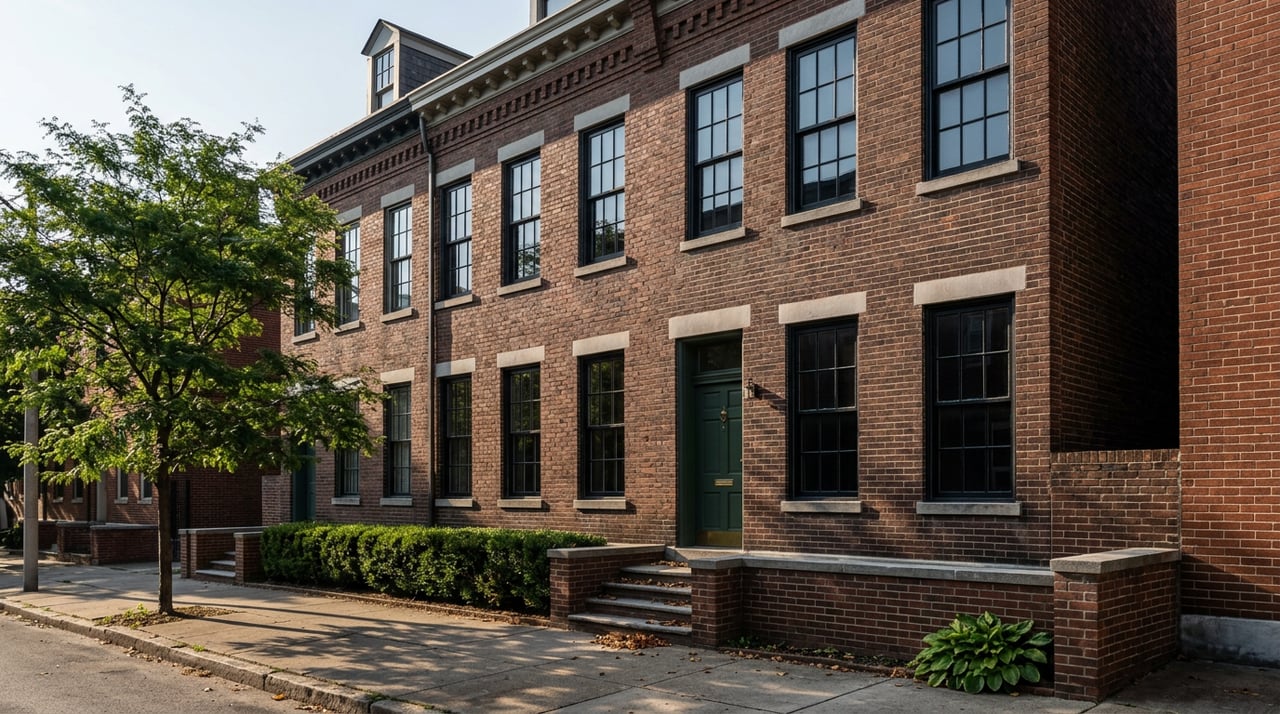
Over the course of 2025, a developer called Volo Holdings pulled a series of permits on two buildings sitting side by side on West Augusta Boulevard in Ukrainian Village. Both were built before 1910. Both sat inside the same historic streetscape of brick worker's cottages and courtyard flats that gives this neighborhood its name recognition. And both went through the city's permit process.
But the projects themselves looked nothing alike. The building at 2114 got a three-story rear addition designed by Hanna Architects, permitted that March at a reported cost of $180,000, followed later in the year by a permit to convert the basement into a fourth residential unit for another $200,000. Next door at 2112, a June permit authorized a $440,000 rehab of the existing six-unit building, tearing off an enclosed rear stairway and rebuilding it from scratch. Three permits, one developer, one block, and a combined price tag north of three-quarters of a million dollars, according to Chicago YIMBY's reporting on the projects.
That is the first thing a buyer needs to understand about Ukrainian Village before writing an offer on a greystone or a two-flat here: the landmark designation that protects this neighborhood's housing stock was not built once. It was built three separate times, in three separate City Council actions, and the boundaries do not track neatly with the name on a listing sheet.
One District, Three Designations, and a Fourth in Progress
According to Wikipedia's Ukrainian Village District entry, the original Ukrainian Village Landmark District was designated on December 4, 2002, covering a compact core along Haddon Avenue, Thomas Street, and Cortez Street between Damen and Leavitt, an area where nearly a third of the 254 buildings were originally built by William D. Kerfoot, the developer who famously reopened his real estate office in a wooden shack days after the Great Chicago Fire of 1871. That first district is the historic spine most people picture when they hear "Ukrainian Village landmark."
It did not stay put. On July 27, 2005, the city added the Walton Street Extension, a four-block stretch of Walton between Damen and Western. On April 11, 2007, a second extension expanded the boundary again. And a third extension, centered on the St. John Evangelical Lutheran Church and School buildings, has been documented in the city's own designation reports as a proposed addition to the district.
You can see this patchwork show up in actual permit records. A Commission on Chicago Landmarks report from late 2023 lists a rear porch extension at 2235 West Cortez Street under the label "Ukrainian Village District Extension II," a specific, separately governed piece of the larger district. That is not a technicality. It means two buildings a few blocks apart can be subject to different designation histories, different review timelines, and in some cases different levels of scrutiny, even though both would show up on a map as "Ukrainian Village."
| Action | Date | Area Covered |
|---|---|---|
| Original District | December 4, 2002 | Haddon, Thomas, and Cortez Streets between Damen and Leavitt |
| Walton Street Extension | July 27, 2005 | Four blocks of Walton Street, Damen to Western |
| Second Extension | April 11, 2007 | Additional blocks beyond the original core |
| Extension III (proposed) | Documented in city designation report | St. John Evangelical Lutheran Church and School buildings |
What "Contributing" Actually Means for Your Renovation
Roughly three-quarters of the broader Ukrainian Village neighborhood sits inside one of these designated boundaries, according to the Chicago Sun-Times, which also notes it took three separate designations across several years to assemble the district as it exists today. The other quarter of the neighborhood sits outside those lines.
Even inside the boundary, not every building carries equal weight. When the Commission on Chicago Landmarks designates a district, it identifies each building as contributing, non-contributing, or potentially contributing. A contributing building generally reflects the district's original architectural character. A non-contributing building may be a house that was substantially altered before the designation. A potentially contributing building might be a cottage currently hidden under old aluminum siding.
This is the distinction a buyer needs to ask about directly, not assume from curb appeal. Two nearly identical brick two-flats on the same block can have different designation categories.
Two Rules That Catch Buyers Off Guard
Once a building is confirmed contributing, the city has review standards. Two of them tend to surprise people who assumed landmark status was mostly about facades and paint colors:
- Windows are expected to be retained and repaired rather than replaced. If replacement genuinely is necessary, the new windows have to closely match the historic originals, a standard the city adopted from the U.S. Secretary of the Interior's guidelines in 1992.
- Chicago's landmark publications identify a dormer policy written specifically for three districts: Old Town Triangle, Ukrainian Village, and the Villa District. It is not a generic citywide rule. It exists because rooftop expansions in these three areas needed their own guardrails.
None of this means renovation is off the table. The Augusta Boulevard permits prove the opposite: additions, basement conversions, and full multi-unit rehabs are moving through the process regularly. But the process itself, and what it will or won't approve, depends on the building's designation status in a way that a listing description rarely spells out.
The Tax Break Buyers Assume, and Usually Don't Get
Cook County's Class L incentive is the tax break most people have heard of in connection with historic buildings, and it is worth naming precisely so the assumption doesn't carry over incorrectly. The City of Chicago's Class L page says Class L reduces the property tax assessment on a landmark building to 10 percent of value for the first ten years, stepping up gradually before returning to normal by year thirteen, but it was built for commercial, industrial, and income-producing non-for-profit buildings, and it requires the owner to invest at least half the building's assessed value in an approved rehabilitation.
That structure means most owner-occupied workers' cottages, single-family homes, and small two-flats in Ukrainian Village don't qualify, regardless of how much history is attached to the address. Buyers pricing in a Class L benefit on a primary residence are usually pricing in a program they won't be eligible for.
Before You Write the Offer
Elsewhere on that same Augusta Boulevard corridor, Castleview Construction has built a five-unit boutique development on a wide 48-foot lot, an entirely different kind of project from the contributing-building rehabs happening nearby. That range, from ground-up new construction to century-old cottage restoration, is part of what makes Ukrainian Village interesting to walk through. It's also exactly why "it's in the landmark district" is not a complete answer to the question a buyer actually needs answered: what, specifically, can be done to this building, and who signs off on it.
Before making an offer on a contributing property here, it's worth confirming the building's designation status and which extension district, if any, it falls under, then talking through the scope of work with an architect who has filed plans with the Commission on Chicago Landmarks before. The rules are navigable. They are just not uniform.
FAQ
Does every building in Ukrainian Village fall under landmark rules? No. Roughly three-quarters of the neighborhood sits within one of the designated district boundaries. The remaining buildings are not subject to the same design review.
Can I get a property tax break for renovating a landmark rowhouse I plan to live in? Usually not through Class L, which was built for commercial, industrial, and income-producing non-for-profit buildings and requires a minimum investment of half the building's assessed value. Owner-occupied homes typically don't fit that structure.
Can I add a rear addition or a basement unit to a contributing building? Yes. Recent permit activity on West Augusta Boulevard shows exactly that kind of work moving through the process, including a rear three-story addition and a basement conversion to a fourth unit. The scope and design still go through Historic Preservation staff review.
If you're weighing a purchase in Ukrainian Village and want to understand what a specific address can and can't do before you write an offer, Vesta Preferred Realty can help you check the building's designation status and walk through what renovation actually looks like here. Get a Home Valuation to start the conversation.
This article is general information, not legal, tax or financial advice. Consult a qualified professional about your situation.