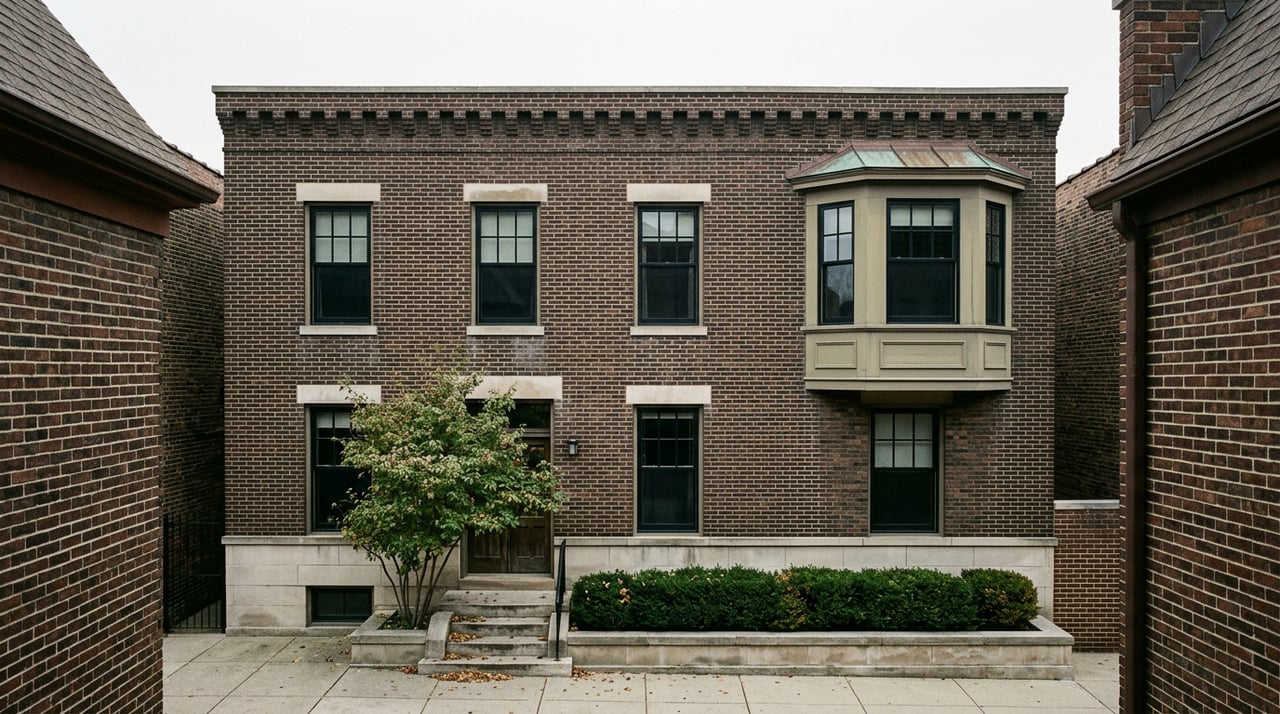
A buyer under contract on a graystone on Arlington Place sees the seller's most recent tax bill: assessed value frozen, well below what a comparable renovated three-flat two blocks over is paying. The listing mentions the home sits in a historic district. The buyer's agent mentions it too, in passing, the way people mention a building has good bones. Nobody asks the one question that actually matters here: does that frozen number belong to the house, or to the person selling it?
It belongs to the person selling it. The freeze does not transfer at closing, and that single fact reshapes what a landmark-district purchase in Lincoln Park actually costs, on top of a second fact almost as easy to miss: the rulebook governing that house isn't fixed. Chicago added three new individually designated Lincoln Park landmarks this past May, and that same month the neighborhood association charged with reviewing changes to the district's other buildings sent a formal objection to a pending proposal. Buying vintage here means buying into a set of protections and obligations that are actively being written, not a static plaque on a wall.
The Freeze Resets the Day the Deed Records
The program most owners mean when they say "our taxes are frozen" is Illinois' Historic Residence Assessment Freeze Law, run through the state's historic preservation office. It freezes a qualifying owner-occupied home's assessed value for eight years, then steps it back up to market level over four more, twelve years total. To qualify, the owner has to spend at least 25 percent of the assessor's fair cash value on an approved rehabilitation within a 24 month window, and the work has to meet the Secretary of the Interior's Standards for Rehabilitation, meaning street-visible historic features get retained even while kitchens and baths get modernized underneath.
None of that carries over in a sale. The program's own rules are explicit: if the property sells, or stops being the owner's principal residence, the freeze cancels and the assessor resets the value to current market level. A new owner can apply for a fresh freeze, but only by spending their own 25 percent of the revised value on a new rehabilitation. The state does allow a developer to complete Parts 1 and 2 of the application, do the work, then hand a buyer an unsigned Part 3. But that buyer has to move in as a primary residence and submit it themselves to actually receive the benefit. A recently rehabbed historic home advertised with a "frozen" tax bill might mean one of two very different things: a freeze already locked in place, or a freeze that exists only on paper until you sign for it.
Two Programs, and Only One Applies to a House
Listings sometimes fold Cook County's Class L incentive into the same sentence as the residential freeze, as though they're interchangeable. They aren't. Class L is a commercial and industrial incentive, reducing the assessment on a landmark building's commercial or industrial portion to 10 percent for ten years, 15 percent in year eleven, 20 percent in year twelve, provided the owner invests at least half the building's value in rehabilitation and secures both city and county sign-off first.
That distinction matters most for a mixed-use building, common enough on Clark Street inside Mid-North's boundary:
- Ground-floor retail or commercial space may qualify for Class L, if the owner applied before construction started and the city supported the request.
- Residential floors above do not qualify for Class L at all. They fall under the owner-occupied residential freeze instead, with its own separate 25 percent threshold and its own non-transfer rule.
A buyer evaluating carrying costs on a landmark-district building with ground-floor retail needs to know which incentive covers which portion, because they're calculated on different bases, run on different timelines, and transfer under different conditions, or don't transfer at all.
The Rulebook Just Got Longer
Three Lincoln Park buildings cleared the City Council's zoning committee for individual landmark status in May 2026: the 1888 Roger Brown Home and Studio at 1926 N. Halsted St., where the Imagist painter lived and worked from 1974 until shortly before his death in 1997, and DePaul University's Byrne Hall and Cortelyou Commons, the latter opened in 1930. Ald. Timmy Knudsen (43rd) called them the first individual landmark designations approved anywhere in Chicago this year, noting a third of the city's individual designations since 2025 now sit in his ward, alongside Wax Trax! Records, landmarked in May 2025. "I'm proud of the pace at which we're working to permanently preserve the ward's most historic properties," he said.
That pace is not abstract to anyone with an offer in on a Mid-North or Arlington-Deming property right now. The Mid-North Association, the volunteer group Chicago's Historic Preservation Division works with on zoning relief and modification requests inside the district, sent a formal letter of opposition to a pending development proposal to Alderman Knudsen on May 18, 2026. A property that wasn't under any kind of Commission scrutiny when you wrote your offer can be squarely in the middle of a live review by the time you close. Ask your listing agent for the property's current review status directly from the Historic Preservation Division, not from a listing description written before this past May.
Mid-North and Arlington-Deming Are Not the Same Neighborhood
The two districts most Lincoln Park landmark inventory sits inside get treated as interchangeable shorthand for "old and protected." They're not the same place, architecturally or procedurally. Mid-North runs from Fullerton to Armitage, Lincoln to Clark, roughly 480 buildings built between 1871 and 1900, designated a Chicago Landmark in 1977. Arlington-Deming exists because of a code loophole: after the 1871 fire, Chicago required masonry construction inside city limits, but the blocks that became Arlington-Deming sat just outside those limits at the time, in the Township of Lake View, so builders there used a wider mix of materials. Architects Samuel N. Crowen, who later designed the Willoughby Tower and the Biograph Theater, and Henry Ives Cobb, who planned the University of Chicago's original campus and designed the Newberry Library, both have work standing in the district today.
Two districts a few blocks apart means two different sets of contributing-building rules, two different conversations with Commission staff about what counts as a compatible material or window replacement. A property just outside either boundary may carry none of these obligations. The only way to know which rulebook, if any, applies to a specific address is the city's own zoning and land use map, not a general sense that "Lincoln Park is historic."
What the Timeline Actually Costs
Chicago's Historic Preservation Division reviews every permit application touching a landmark or landmark district property. Most work gets cleared at the staff level, and the division encourages a pre-permit submission to sort out requirements before you file. Projects involving new infill construction, additions, or demolitions requiring City Council review go to a full Commission hearing instead, which adds months to the schedule rather than weeks.
Compare that to what's happening on the same block just outside either district right now. At 601 W. Diversey Parkway, developer Validus Capital secured a permit to convert the shuttered 70-room Inn at Lincoln Park into 40 residential units, a $350,000 project. Directly across the intersection at 2701 N. Clark St., Contemporary Concepts is adding two stories to the former Leon Hotel SRO building, turning it into 25 units with ground-floor retail, a $4 million undertaking. Neither building sits inside Mid-North or Arlington-Deming, and neither needed a Commission hearing to add square footage. That's the actual tradeoff a landmark-district address buys you: slower, more deliberate review on exterior work, in exchange for protection against a teardown showing up next door.
Before You Write the Offer
- Ask for the property's exact district name, not just "Lincoln Park historic," and confirm it against the city's zoning map rather than the listing sheet.
- If the tax bill shows a frozen assessment, ask directly whether it's the seller's freeze, which ends at closing, or an unsigned Part 3 waiting for a new owner-occupant to claim it.
- Budget renovation timelines around the Commission-hearing track unless your contractor has already confirmed the scope of work only needs staff-level review.
- If the building has ground-floor commercial space, ask which portion, if any, was approved for Class L before construction started, since it won't cover the residential floors.
None of this makes a Mid-North or Arlington-Deming purchase a bad idea. Lincoln Park's condo market alone closed a wide range of price points in 2025, from $177,000 studios to $1.95 million units, according to Vesta's own closed transactions, and vintage inventory in these districts holds a real premium precisely because the protections are durable. It just means the tax bill you see today isn't the one you're guaranteed tomorrow, and the district you think you're buying into might add a building, or a Commission hearing, before you get the keys.
FAQ
If I buy a home with a frozen tax assessment, do I keep that frozen rate? No. The freeze is tied to the owner-occupant who earned it through an approved rehabilitation. It cancels at sale, and the assessor resets the value to current market level. You can apply for your own freeze, but only by completing a qualifying rehabilitation of your own.
Are Mid-North and Arlington-Deming the only protected properties in Lincoln Park? No. The city can also designate individual landmarks outside any district boundary, including the Roger Brown Home and Studio and two DePaul buildings approved this past May. Given the pace of designations in the 43rd Ward over the past year, more individual landmarks are a realistic possibility for any older Lincoln Park property, whether or not it currently sits inside a mapped district.
If you're weighing a vintage purchase in Lincoln Park's landmark districts, or wondering what a rehab already underway on a property you're watching actually means for your tax bill, Vesta Preferred Realty can walk through the specific district, incentive, and timeline that apply to that address before you write an offer. Get a Home Valuation to see where your numbers actually land.